
The Lobbi Delivery Team
Operational Systems Engineering
Picture this: it's Monday morning. Your operations manager is logged into four carrier portals, manually checking appointment statuses. Your loan processor is eyeballing a spreadsheet, comparing uploaded documents against a checklist for the twentieth time today. Your front desk coordinator is on hold with an insurance company, verifying eligibility for a patient who's already sitting in the waiting room.
None of these tasks are hard. They're tedious. They're repetitive. And they're eating your best people alive.
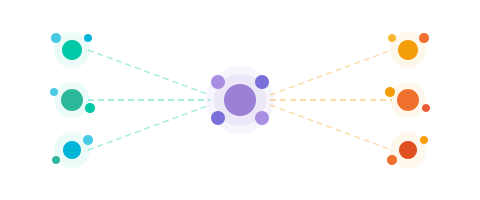
For the past decade, the standard answer was a big automation project. A six-month implementation. A seven-figure contract. A cross-functional steering committee with workstreams and dependencies and a project manager tracking Gantt charts. That era is ending. The next wave of automation isn't big, it's small. It isn't monolithic, it's composable. It isn't a single platform doing everything. It's hundreds of small, focused bots, each one solving a specific problem, each one owned by someone, each one measurable, and all of them coordinated by clear workflows.
This shift is already happening across every regulated industry we work with. The organizations that understand it early are going to move faster, adapt quicker, and operate more efficiently than the ones still waiting for the perfect end-to-end platform to materialize.
Why Big Automation Projects Struggle
Let's start with why the old model is breaking down.
Seventy-two percent of organizations have adopted AI in at least one business function (McKinsey, 2024), but scaling across the enterprise remains a significant challenge [1]. The pattern is painfully consistent: organizations invest heavily in a large automation initiative, achieve some success in a controlled pilot, and then hit a wall trying to expand it.
The reasons aren't technical. They're structural.
Scope creep. Big projects accumulate requirements like barnacles on a ship. Every stakeholder adds their needs. What starts as "automate the renewal process" becomes "automate renewals, integrate with four carrier portals, generate compliance reports, update the CRM, and send personalized emails." The scope becomes undeliverable.
Integration complexity. Large automation projects require integrating multiple systems. Each integration is a dependency. Each dependency is a risk. When one integration breaks, the whole project stalls. You've seen this movie before.
Change resistance. Big projects mean big change. People resist big change. They'll comply with small change. An automation that affects one team's daily workflow is manageable. An automation that affects every department creates organizational antibodies.
Time to value. A six-month project delivers value in month seven, if it delivers at all. A two-week micro-automation delivers value in week three. When leadership asks "what have we gotten from automation?" you want to point to results, not a project plan.
Eighty-eight percent of SMBs using AI say it helps them compete more effectively (Salesforce, 2024) [2]. But the key word is "using." The ones getting value are the ones that deployed quickly and iterated. Not the ones stuck in year-long implementations.
What Micro-Automation Actually Looks Like
A micro-automation is a small, focused automation that solves a single, measurable problem. These aren't hypotheticals, they're real examples from regulated industries:
Insurance: A bot that checks carrier portal appointments every morning and flags any about to expire. Takes 15 minutes to build. Prevents missed appointments that could take weeks to reinstate.
Mortgage: A bot that monitors rate lock expirations and sends alerts to loan officers 72, 48, and 24 hours before expiration. Prevents costly lock extensions and the borrower frustration that comes with them.
Financial advisory: A bot that pulls daily account values for high-net-worth clients and flags any that've moved more than 5% from target allocation. The advisor gets a morning summary instead of manually checking 200 accounts.
Healthcare: A bot that verifies patient insurance eligibility the day before their appointment and flags any issues for the front desk. Reduces day-of surprises and claim denials.
Title company: A bot that monitors county recorder websites and alerts the team when a recorded document is available for download. Eliminates the daily manual check that someone was doing (or forgetting to do).
Each one is small. Each one is focused. Each one solves a specific bottleneck. And each one can be built, tested, and deployed in days, not months. That's the whole point.
The Economics Of Small
The economics of micro-automation are fundamentally different from big projects, and the difference matters most to the companies that can least afford to gamble.
Seventy-three percent of small firms experienced financial challenges in the prior year (Federal Reserve, 2024) [3]. These businesses can't afford $500,000 automation projects that might not work. But they can afford 50 small automations at $5,000 each, especially when each one delivers measurable value independently.
Look at the math side by side:
Big project: $500,000 investment. Twelve-month timeline. Value delivered at the end (maybe). If the project fails, you lose everything.
Micro-automation portfolio: 50 automations at $5,000-$10,000 each. Deployed over 12 months. Each one delivers value independently. If five of them fail, you shut them down and keep the other 45. No drama.
The risk profile is completely different. With micro-automation, failure is cheap and contained. With big projects, failure is expensive and catastrophic.
Deloitte's 2025 Tech Trends report describes this as "composable business", building capabilities from modular, interchangeable components rather than monolithic systems [4]. Micro-automation is composable business applied to operations.
Meanwhile, the World Economic Forum projects that 39% of existing skill sets will be transformed by 2030 [5]. That rate of change means your automation needs to be adaptable. Small, modular automations can be updated, replaced, or retired individually. A monolithic platform? It requires a major overhaul to adapt to anything.
Breaking Large Programs Into Measurable Bottlenecks
The shift to micro-automation starts with how you identify what to automate. Instead of asking "what process should we automate?" ask something sharper: "Where are we losing time, money, or quality right now?"
Map your operations and find the bottlenecks. Not the big, obvious ones that'd require a major project. The small, specific ones that one person or one team deals with every single day.
Step 1: Identify The Bottleneck
Walk through your core workflows. Where do things slow down? Where do errors happen? Where does someone say "I hate doing this" or "this takes forever"?
In an insurance agency, common bottlenecks include:
- Checking carrier portals for policy documents
- Formatting commission data from different carriers into a standard layout
- Following up on missing information from clients
- Generating certificates of insurance for common requests
- Reconciling payment records across systems
Each of these is a specific, contained problem. Each one can be measured.
Step 2: Measure The Cost
Before you build anything, quantify the bottleneck:
- How many times per week does this happen?
- How long does it take each time?
- What's the error rate?
- What's the downstream impact of errors or delays?
Say a loan processor spends 30 minutes per file checking document completeness, and they process 20 files per week. That's 10 hours per week. At their loaded cost, that might be $750 per week, or $39,000 per year. A bot that checks document completeness in 30 seconds per file pays for itself in the first month.
Step 3: Build The Smallest Possible Automation
Don't over-engineer. Build the minimum viable automation that addresses the bottleneck. If the problem is "checking carrier portals for documents," the bot doesn't need to file the documents, update the AMS, and notify the client. First version: check the portal, download the document, put it in a folder. That's it. Ship it.
Step 4: Measure The Result
After deployment, measure the same metrics you measured before. Did time per task decrease? Did error rates drop? Did throughput increase? If yes, keep it. If no, fix it or retire it.
The organizations capturing the most value from AI focus on measurable business outcomes, not technology metrics (McKinsey, 2024) [1]. Number of bots deployed isn't a success metric. Hours saved per week is.
Shared Standards: The Glue That Holds It Together
Now here's where micro-automation can go wrong. If every team builds their own bots with their own conventions, you end up with a different kind of mess. Instead of one big ungovernable project, you've got 200 small ungovernable bots. Shadow automation at scale.
You need shared standards. Not heavy-handed governance, practical standards that make each bot manageable and the portfolio comprehensible.
Naming Conventions
Every automation should follow a naming convention that tells you what it does at a glance:
`[Department]-[Process]-[Action]-[Version]`
Examples:
- `ops-renewal-check-carrier-appointment-v2`
- `mortgage-processing-doc-completeness-check-v1`
- `billing-commission-reconcile-carrier-data-v3`
When you've got 200 automations, naming isn't a nicety. It's infrastructure.
Ownership Registry
Every automation has a named owner. Not a team, a person. Maintained in a central registry that includes:
- Bot name and description
- Owner (person, not team)
- Systems it connects to
- Credentials it uses
- Last reviewed date
- Business outcome it supports
The NIST AI Risk Management Framework emphasizes the importance of accountability in automated systems [6]. An ownership registry is accountability made practical.
Monitoring Standards
Every automation should report:
- When it ran
- What it processed
- Whether it succeeded or failed
- How long it took
This doesn't require expensive monitoring infrastructure. A shared log format and a simple dashboard that aggregates bot health is enough to start. You can get fancy later.
Gartner predicts that by 2029, agentic AI will resolve 80% of common customer service issues without human intervention [7]. Those agentic systems will be composed of many small, coordinated automations, and monitoring each one will be essential to monitoring the whole.
Error Handling Standards
Every automation should handle errors the same way:
- Log the error with enough context to diagnose it
- Notify the owner
- Fail gracefully, don't corrupt data or leave processes in an inconsistent state
- Provide a manual fallback path
When a bot fails at 6 AM, the owner should get a notification that says what happened, what data was affected, and what to do next. Not a cryptic error message. Not silence.
Scale By Composition
The real power of micro-automation isn't any single bot. It's the ability to compose bots into workflows.
Consider a mortgage company's loan processing workflow:
- Document collection bot monitors the borrower portal and flags when new documents are uploaded.
- Document classification bot identifies the document type (pay stub, bank statement, tax return, etc.).
- Completeness check bot compares uploaded documents against the loan's requirements checklist and flags what's still missing.
- Data extraction bot pulls key data points from the documents (income, assets, employer).
- Stale file bot flags loan files that've been waiting on documents for more than 7 days and triggers a follow-up email.
Each bot does one thing. Each can be built, tested, and deployed independently. But together, they automate a significant portion of the document collection workflow.
That's composition. The workflow is the orchestrator. The bots are the workers. You can add a new bot without changing the others. You can replace a bot without disrupting the workflow. You can turn off a bot that isn't working without taking down the whole process.
Build small. Compose large. Adapt continuously. Deloitte's research on composable architecture backs this up [4], and Salesforce's data on SMB technology adoption tells the same story [2], the most effective technology strategies are incremental, not significant. Micro-automation is inherently incremental. You start with one bot. Add another. Compose them. Measure. Iterate.
What The Workforce Shift Means For This Model
The World Economic Forum projects that technology literacy, AI and big data skills, and creative thinking will be the most in-demand competencies by 2030 [5]. This has direct implications for how you staff your micro-automation program.
You don't need a team of software engineers. You need people who understand the business process and can build simple automations. The rise of no-code and low-code tools means that the person who understands the insurance renewal process best, the account manager, can also be the person who builds the bot that automates the repetitive parts of it.
This is a meaningful shift: from "IT builds automation for the business" to "the business builds automation with IT's guardrails." The guardrails are the shared standards, naming conventions, ownership registry, monitoring, error handling. IT provides the infrastructure. The business provides the domain expertise and builds the bots.
Gartner's cybersecurity research underscores the need for governance in this model [8]. When more people are building automation, the attack surface grows. Credential management, data access controls, and audit logging become even more important. But these are solvable problems. They require standards, not prohibition.
Getting Started: Your First 30 Days
Here's a practical plan for launching a micro-automation program. Nothing theoretical. Just do this.
Week 1: Pick Three Bottlenecks
Talk to your operations team. Identify three specific, measurable bottlenecks. Not big, strategic problems. Small, daily annoyances. The things people complain about in the break room. Start there.
Week 2: Measure The Baselines
For each bottleneck, measure:
- Time spent per occurrence
- Frequency per week
- Error rate
- Downstream impact
If you can't measure it, pick a different bottleneck.
Week 3: Build The First Bot
Pick the simplest bottleneck and build the smallest possible automation. Use whatever tool makes sense, Power Automate, Zapier, a simple script. The goal isn't perfection. The goal is "does this work and does it save time?" That's the only question that matters.
Week 4: Measure, Document, Iterate
Measure the same metrics you measured in Week 2. Document the bot using the shared standards (name, owner, systems, credentials). If it worked, celebrate. If it didn't, learn and try the next bottleneck.
Months 2-3: Scale The Pattern
Build more bots. Refine the standards. Start composing bots into workflows. Build the ownership registry. Set up basic monitoring.
Month 4+: Govern And Grow
Quarterly reviews. Retire bots that aren't needed anymore. Replace bots that've outgrown their initial implementation. Onboard new bot builders with training on the standards.
Why This Matters For Regulated Industries
Regulated industries have been hesitant about automation, and honestly, that hesitation wasn't unreasonable. The compliance risk feels too high. The stakes feel too real. With big automation projects, a failed implementation can trigger audits, fines, and reputational damage.
Micro-automation changes the risk equation. Each bot is small enough to understand fully. Small enough to audit. Small enough to shut down without disrupting everything else. Your compliance team can review a two-page spec for a single bot. They can't review a 200-page specification for a platform implementation. Nobody can.
The NIST AI framework's emphasis on proportionate governance [6] aligns perfectly here. The governance overhead should match the risk. A bot that checks carrier appointments has different governance needs than a bot that generates client-facing documents. Micro-automation lets you calibrate governance to risk at a granular level.
And the Federal Reserve data on small business challenges [3] makes the case for speed. Small firms need to see results quickly. They need to know their investment is working before they invest more. Micro-automation delivers that fast feedback loop.
The Coordination Challenge
Let's be honest about the hard part. Coordinating hundreds of small automations is a real challenge. Without discipline, you end up with a tangled web of bots that nobody fully understands.
This is where the shared standards earn their keep. Naming conventions make bots findable. The ownership registry makes them accountable. Monitoring makes them visible. Error handling makes them reliable.
But standards alone aren't enough. You also need:
A bot catalog. A living document (or simple application) that lists every active bot, what it does, and how it fits into the broader workflow. Think of it as a table of contents for your automation portfolio.
Dependency mapping. When Bot A feeds data to Bot B, that dependency should be documented. If Bot A breaks, you need to know that Bot B will also be affected.
Retirement criteria. Not every bot should live forever. Define when a bot should be retired: when the process it supports changes, when a better solution exists, when it hasn't run successfully in 90 days.
A communication channel. Bot builders should be able to share what they've built, ask for help, and learn from each other. A shared Slack channel or Teams group is enough.
The most adaptive organizations invest in coordination mechanisms, not just capabilities (McKinsey, 2024) [1]. Micro-automation is a capability. The standards, catalog, and communication channels are the coordination mechanisms.
The Future Is Many Small Things Working Together
The era of big, monolithic automation projects is giving way to something more organic. More adaptable. More resilient.
Think of it like an ecosystem. A forest isn't one tree. It's millions of organisms, each doing their part, connected by shared soil and water and sunlight. When one tree falls, the forest survives. When conditions change, the ecosystem adapts.
Your automation portfolio should work the same way. Many small bots. Each doing one thing well. Connected by shared standards and clear workflows. When one bot breaks, the others keep running. When a process changes, you update one bot. not the entire system.
Gartner's customer service predictions [7], the World Economic Forum's workforce projections [5], Deloitte's composable business research [4], they all point in the same direction. The future is modular. The future is composable. The future is small things working together.
If you're ready to start building that future in your business, we can help. We'll identify the right bottlenecks, set up the standards, and build your first bots. We've done this for insurance agencies, mortgage companies, financial advisors, and healthcare practices. The pattern works. The results are measurable. And you'll see them in weeks, not months.
Book a discovery call at thelobbi.io/discovery.
Topic clusters
Ready to see where the friction is?
The Lobbi's Operations Discovery maps your workflows, identifies your highest-impact bottlenecks, and gives you a clear picture of what's possible.